Hail damage roof signs in Houston
Hail drives most Texas roof claims. Learn the signs before you file.
This guide shows how to file an insurance claim for roof damage in Texas, step by step. Learn when damage qualifies, what roof claim documentation to gather before filing, how the adjuster visit works, and the mistakes that sink valid Texas roof insurance claim filings. Call now at (619) 775-3787 to speak with a roofing specialist.
Speak to a roofing specialist (619) 775-3787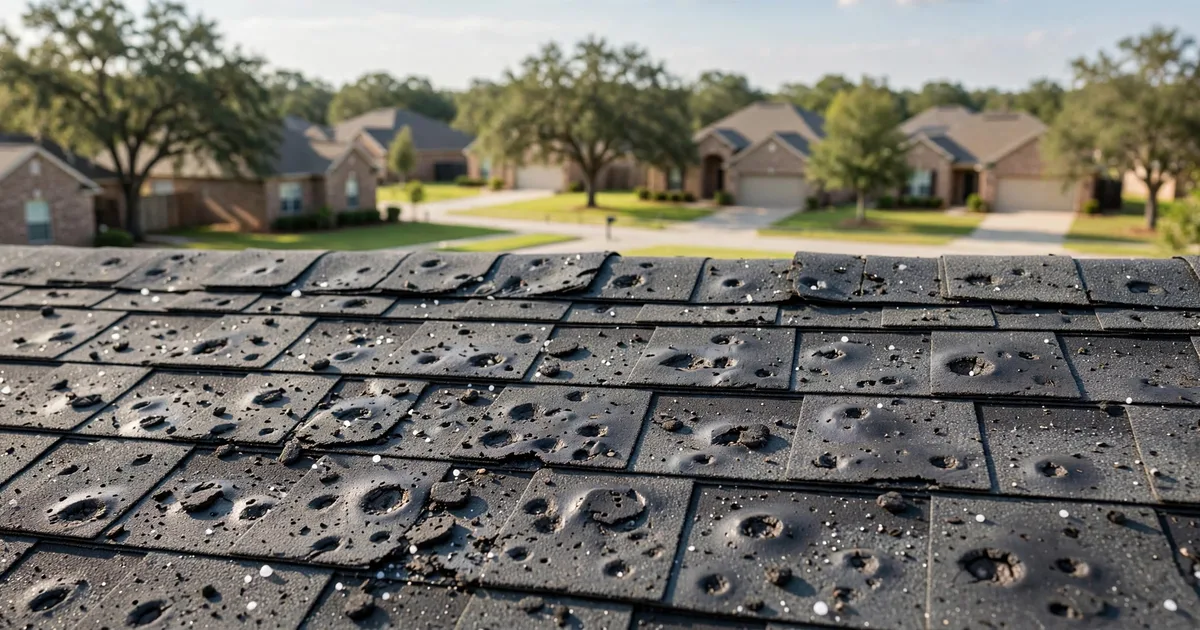
Roof damage qualifies when a sudden event like wind, hail, or falling debris causes it, not when age or neglect causes it. Texas policies cover sudden and accidental damage. They exclude wear, rot, and long-term neglect. The adjuster's first question is always which storm caused the damage.
Actual cash value is the replacement cost minus depreciation. Replacement cost value is the price of a new roof with no depreciation deduction. Many Texas carriers settle older roofs at actual cash value. A 15-year-old shingle roof under actual cash value terms pays a fraction of replacement cost.
According to the Insurance Information Institute (2024), wind and hail account for roughly 41 percent of all homeowners insurance claims, far ahead of any other cause. That share explains why Texas carriers write separate wind and hail deductibles into most policies. Storm damage qualifies. A 22-year-old roof with curled shingles and no storm event does not.
Covered perils in a standard Texas policy include wind, hail, falling objects, and fire. Excluded causes include wear, rot, mold from neglect, and settling. Read the exclusions page of your policy before filing. Filing a claim for an excluded cause wastes the deductible and adds a claim to your history.
Wind-driven rain through an undamaged roof is generally not covered; the policy covers openings the storm created. A missing shingle that lets rain in qualifies. Intact shingles with attic moisture do not.
Call now and speak to a roofing specialist about your roof.
Document the damage date, wide and close-up photos of every damaged area, and any temporary repair receipts before filing. Strong roof claim documentation decides claims before the adjuster arrives. Carriers deny what they cannot see.
Mitigation is the emergency work that stops further damage, like tarping. Policies require it. Skipping mitigation gives the carrier grounds to reduce the payout. A roof inspection in Houston documents damage professionally when you cannot reach the roof safely, and the written report backs the claim file.
Photograph in layers. Start with a wide shot showing the whole slope, then a medium shot of the damaged area, then a close-up of the specific damage. Include a ruler or coin for scale in close-ups. Take 40 to 60 photos for a typical claim; adjusters never complain about too much evidence.
Store everything in one claim folder: photos, the timeline, weather reports, receipts, and every email with the carrier. Adjusters rotate; your folder keeps the file consistent across handoffs. Digital backups protect against a lost phone or a dead laptop.
You file by calling your insurer's claims line, giving the policy number and damage date, and requesting a claim number and adjuster assignment. File within 24 to 72 hours of discovering the damage. The clock matters more than most homeowners expect.
Texas law requires insurers to acknowledge a claim within 15 days and accept or reject it within 15 business days after receiving all requested documentation. Write down every commitment the representative makes, with names and dates. For active leaks that cannot wait for paperwork, emergency roof repair in Houston stops the water while the claim moves forward.
Expect the carrier's timeline to run 2 to 6 weeks from filing to settlement on a straightforward claim. Complex claims with disputed scopes run 2 to 4 months. Stay in contact weekly. Silence from the carrier usually means the file is waiting on a document, not moving forward.
The adjuster inspection involves a roof walk, measurements of damaged slopes, and photos that the carrier uses to set the settlement. The adjuster works for the carrier, not for you. Preparation closes that gap.
Be present for the inspection. Walk the adjuster to every damaged area your documentation shows. Ask which slopes the adjuster counts as damaged and why. Request the adjuster's scope in writing before leaving. Compare it against your roofer's scope line by line.
Adjusters miss damage on steep or complex roofs, and they work fast. Call (619) 775-3787 to speak with a roofing specialist before the adjuster visit. A roofer on site during the inspection points out damage the adjuster might walk past.
The written scope lists each damaged slope, the squares involved, and the line-item prices. Compare the adjuster's square count against your roof's actual size. A 25-square roof (2,500 square feet) with 3 damaged slopes should show roughly 15 to 20 squares in the scope, not 5.
Ask the adjuster to explain any slope marked undamaged. Slopes facing away from the storm often escape damage, but ask anyway. The explanation goes in your notes and supports an appeal when a second look finds damage the first visit missed.
Photograph the adjuster's chalk marks before leaving the roof. Those marks show exactly which damage the carrier counted. When the roofer's count differs, side-by-side photos of the same test area make the supplement request concrete.
The most common mistakes are waiting too long to file, throwing away damaged materials, and signing a contractor's assignment of benefits without reading it. Each mistake hands the carrier a reason to pay less.
Assignment of benefits is a contract that transfers your claim rights to a contractor. It removes your control over the claim. Texas restricted these agreements for good reason. Keep every damaged shingle and photo until the claim closes. Mitigation work like roof leak repair in Houston protects the claim; permanent replacement before documentation kills it.
Watch for contractor red flags during the claim. Demands for full payment upfront, pressure to sign before the adjuster visit, and out-of-state license plates after a storm all signal trouble. Legitimate Houston roofers wait for the adjuster, work from the written scope, and collect the deductible as the contract requires.
Texas wind and hail deductibles work as a percentage of the dwelling coverage, typically 1 to 5 percent, paid out of pocket before the insurer pays. This deductible differs from the flat deductible on the policy's front page.
According to the Insurance Information Institute (2024), Texas policies commonly carry separate wind and hail deductibles of 1 to 5 percent of the insured dwelling value. On a $350,000 home, a 2 percent deductible equals $7,000 out of pocket before the insurer pays anything on the claim. Coastal counties often carry higher hurricane deductibles on top of that.
Do the math before filing. A $12,000 roof replacement with a $7,000 wind and hail deductible and $3,000 in depreciation leaves a $2,000 carrier payment. Some homeowners in that position pay out of pocket and skip the claim. A roofer's inspection tells you which side of that line you sit on.
A Texas roof insurance claim succeeds on documentation and timing. Gather your roof claim documentation, file an insurance claim within 72 hours of discovery, and call now at (619) 775-3787 to speak with a roofing specialist about next steps.
Check your policy's reporting deadline first; many Texas policies set it at 1 year from the damage date. File within 72 hours of discovery regardless. Fast filing preserves evidence and keeps the damage tied to the right storm.
A single weather-related claim does not automatically raise premiums. Multiple claims within 3 to 5 years affect renewals and pricing. Texas insurers weigh claim frequency more than any single storm event.
Request a reinspection and point to the damage the first adjuster missed. Get an independent roof inspection with photos and a written scope. File a formal appeal with the carrier using that documentation. The Texas Department of Insurance takes complaints when carriers stall.
Insurance pays for full replacement only when the damage meets the policy's threshold across enough of the roof. On older roofs, carriers subtract depreciation first under actual cash value terms. The gap between the depreciated payout and the replacement cost comes out of pocket.
Hail drives most Texas roof claims. Learn the signs before you file.
Reported cost ranges to compare against your adjuster's settlement.
Active leak while the claim is pending? Emergency crews stop the water first.