roof leak repair services
Local leak diagnosis and repair across the Houston metro.
Water coming in around the chimney almost always means one thing: the flashing system has failed. This guide covers the roof leaking around chimney flashing, the signs of chimney flashing failure, what flashing repair involves, and when masonry work is needed too. Chimney flashing, roof leaking around chimney, flashing repair: act now by calling (619) 775-3787 to reach a roofing specialist.
Speak to a roofing specialist (619) 775-3787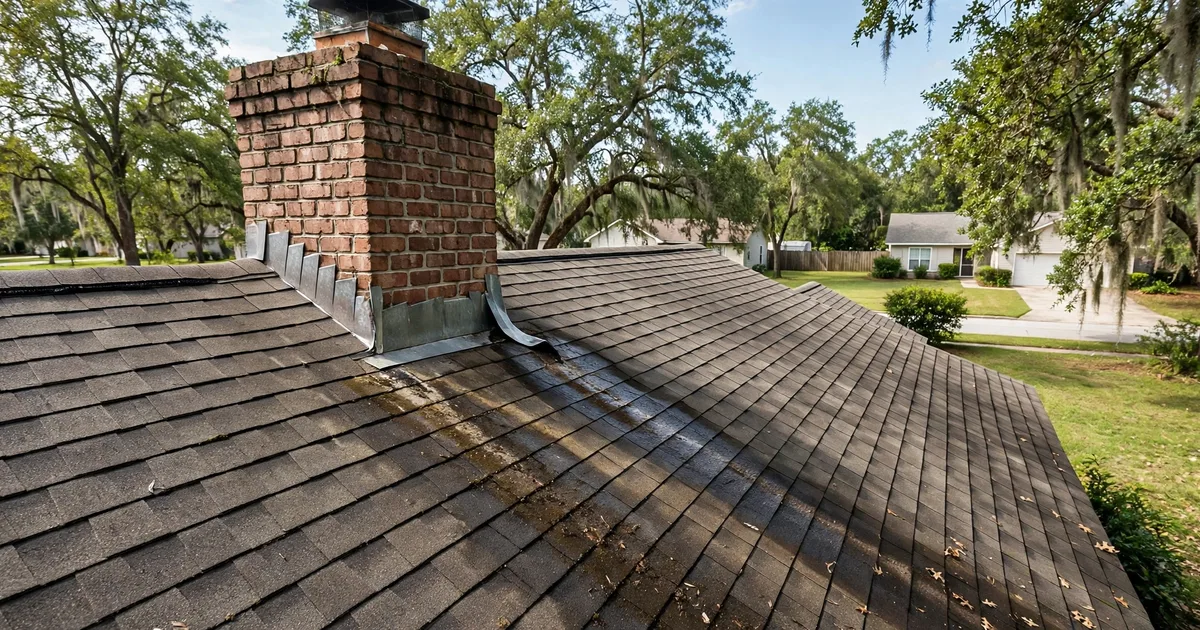
A roof leaks around the chimney because the flashing system that seals the roof-to-chimney joint has failed. Chimney flashing is the layered metal system of step flashing and counterflashing that seals the joint where a chimney meets the roof. Step flashing runs up the roof slope in L-shaped pieces. Counterflashing folds into the mortar joints and overlaps the step flashing. Together they shed water past the joint.
The joint moves. Brick expands in heat and contracts in cold. The roof deck flexes under wind loads. Houston adds 50 inches of annual rain and long stretches above 100 degrees (NOAA climate normals). Each cycle works the seal. Nails back out. Caulk lines crack. Metal fatigues at the bends. The failure usually starts small: a lifted corner, a cracked seal line, a nail head that has popped through.
Chimneys concentrate water. Every slope above the chimney dumps runoff against the back of the masonry. That is why a cricket exists: a cricket is the small peaked diverter that sheds water around the back of a wide chimney. Without a cricket, the back joint takes the full flow of the roof above it and fails years earlier.
Call now and speak to a roofing specialist about your roof.
The signs of chimney flashing failure are ceiling stains near the chimney, rust streaks on the brick, crumbling mortar, and lifted or separated metal at the joint. Catch the signs early and the fix stays a flashing job. Ignore them and water reaches the framing.
One sign justifies an inspection. Two signs justify a fast one. Water that reaches the ceiling has already crossed the underlayment and the decking.
A roofer finds the exact leak point with a staged water test that starts low on the chimney and moves up the joint in sections. Guessing wastes time. The stain on the ceiling often sits feet from the actual breach, because water travels along rafters before it drips.
The test runs in stages. A helper runs a garden hose at low flow against the lowest flashing course for 15 minutes. A second person watches inside the attic for the first drip. Dry after 15 minutes? Move up one course and repeat. The test isolates the failing course within an hour. The roofer then inspects that course up close: the step flashing laps, the counterflashing reglet, the seal lines, and the cricket behind the chimney.
The inspection covers the full joint before any work starts. Fixing the front course while the back course leaks guarantees a callback. A complete diagnosis maps every weak point on all four sides of the chimney.
Chimney flashing repair means removing the old flashing, cutting new step flashing and counterflashing, and sealing every joint with roofing cement. The crew strips the shingles around the chimney base first. Old step flashing comes out with the nails. The brick gets cleaned where the new counterflashing will sit.
New step flashing goes in course by course, each L-piece lapped under the shingle above it. The counterflashing gets cut into the mortar joints and folded over the step flashing. Polyurethane sealant fills the reglet. The crew then re-shingles the disturbed area and rebuilds the cricket behind the chimney when the chimney is wider than 30 inches.
Material choice sets the lifespan. Galvanized steel runs 15 to 20 years in Houston. Aluminum runs 20 to 25 years. Copper runs 50 years or more. Local roof leak repair services price the repair by chimney size, stories, and material. Call (619) 775-3787 to describe the leak and schedule the diagnosis.
A chimney leak needs masonry work too when the mortar joints are crumbling, the crown is cracked, or the brick faces are spalling. Spalling is the flaking of brick faces caused by freeze-thaw cycles and trapped moisture. Each defect opens a water path that new flashing alone cannot close.
Tuckpointing rebuilds the mortar joints. The mason grinds out the failed mortar to a depth of about 0.75 inches and packs in fresh mortar. A cracked crown gets rebuilt with a sloped concrete or mortar cap that sheds water away from the flue. Spalled brick courses get replaced brick by brick. Each job carries its own reported range, separate from the flashing work, and the price moves with chimney height and access.
The rule is simple: seal the masonry before sealing the joint. Fresh counterflashing bedded into crumbling mortar pulls loose within a season. A chimney that passes the masonry check gets flashing that lasts its full rated life.
Reported cost ranges for chimney flashing repair in Houston run $200 to $600 for a standard repair. That range covers the crew visit, the new step flashing and counterflashing, the sealant, and the shingle work around the base. Chimneys wider than 30 inches cost more because the cricket adds material and labor.
Three factors move the price. Chimney size sets the linear feet of flashing. Two-story height adds ladder and staging time. Material choice sets the metal cost: copper runs several times the price of galvanized steel. The reported roof repair cost ranges in Houston cover flashing and every other common repair tier.
Masonry work sits on a separate ticket. Tuckpointing and crown rebuilds run from the hundreds into the low thousands depending on chimney height and access. Get both scopes in writing before the work starts.
You keep a chimney from leaking again by resealing the counterflashing joint every 5 to 8 years and inspecting the flashing after every major storm. The counterflashing seal line takes the most weather. A fresh bead of polyurethane sealant there every few years stops most failures before they start.
Storm inspections matter in Houston. Wind lifts the step flashing corners. Hail dents the metal and cracks the seal lines. A 10-minute ground check after each major storm catches the damage while the fix is still small. Clear leaves and branches off the cricket each spring so water keeps flowing around the chimney instead of pooling behind it.
Chimney flashing, roof leaking around chimney, flashing repair: act now by calling (619) 775-3787 to reach a roofing specialist. A small leak at the joint becomes a framing repair when it waits.
Start with the flashing. Flashing failure causes most chimney leaks. The metal cracks, lifts, or separates from the brick. The masonry behind it fails less often. A staged water test separates the two causes in under an hour.
A tube of caulk works as a short-term stopgap. It is not a repair. Caulk shrinks and cracks under Houston sun within months. Proper repair means cutting new step flashing and counterflashing into the mortar joints. That repair lasts 15 to 25 years with galvanized or aluminum metal.
New galvanized steel flashing lasts 15 to 20 years in Houston. Aluminum lasts 20 to 25 years. Copper lasts 50 years or more. Heat, rain, and salt air set the pace. Resealing the counterflashing joint every 5 to 8 years stretches every material toward the top of its range.
Old flashing does not hurt a claim. Insurers pay for sudden storm damage, not age. A 20-year-old flashing system that a storm finally broke still qualifies under most wind peril clauses. The adjuster looks for the date of loss and the storm that caused it.
Local leak diagnosis and repair across the Houston metro.
What a brown stain on the ceiling says about a roof leak.
How Texas homeowners file wind and hail roof claims.